Nadahnut prevod odlomka iz potpoglavlja Kako se kaže ženski samuraj? iz romana Cimetna pisma, dijamantna stvorenje koji je uradio Will Firth (kao i kratak teaser), a objavio magazin European Literature Network. Pored prevoditelja velika zahvala ide za Rosie Goldsmith koja nam je objavila ovaj dio iz romana za koji trenutno nemamo izdavača u UK ni drugdje na engleskom govornom području. Moj bazični izdavač Istros Books iz Londona je pokušao dobiti grant za prevod i štampanje knjige ali je bio odbijen. Donosim cijeli prevod teksta s opremom ELN-a.
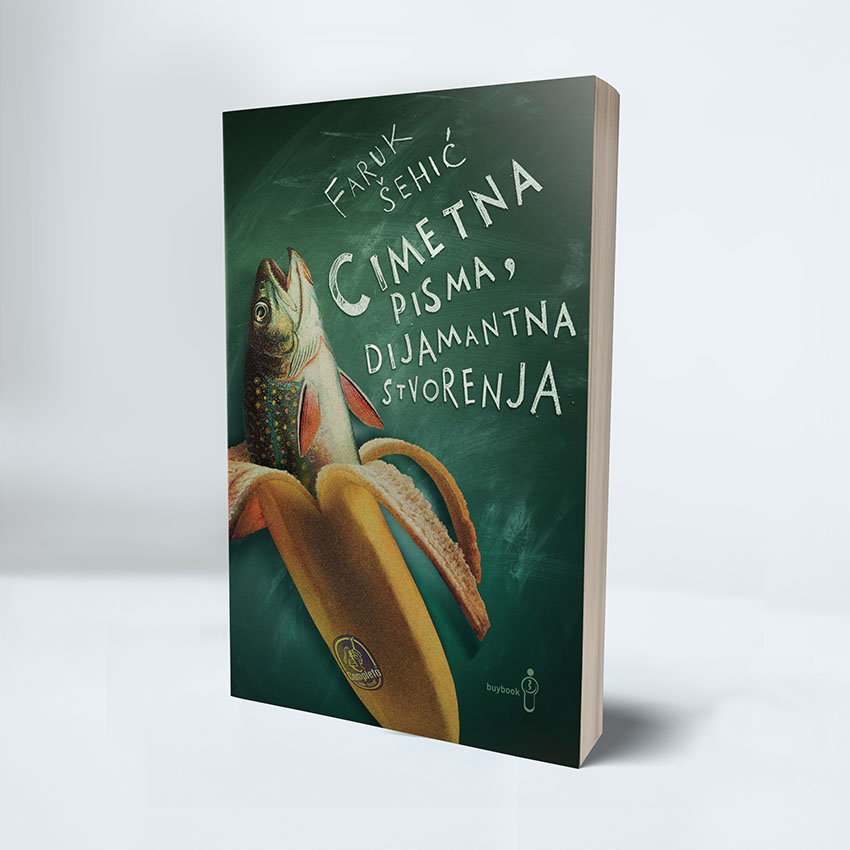
What do you call a female samurai? from CINNAMON LETTERS, DIAMOND CREATURES by Faruk Šehić, translated by Will Firth
Despite the success of his novel Quiet Flows the Una (2011), Faruk Šehić’s Cinnamon Letters, Diamond Creatures (2024) has yet to be fully translated and to make waves in the Anglo-American world. While Quiet Flows the Una deals heavily with the immediate effects of the Bosnian War (1992-95), his latest novel moves on to more reflective planes full of symbolism and fascinating imagery. Cinnamon Letters, Diamond Creatures is a speculative study of the long-term psychological effects of war and people’s attempts to cope with trauma. The subheading “saga of the survivors” is highly appropriate, but it is the literary qualities of Šehić’s new novel that make it a mind-bending read.
by Will Firth
What do you call a female samurai?
from Cinnamon Letters, Diamond Creatures
Mum has given up on life. I’ve learned to use words in a figurative sense. Dad is missing in action. I survived a mock execution, but life goes on. There’s no other way – you have to go on living. I lived in abandoned houses. At least there were plenty of them. I slept during the day and foraged at night. I looked for food, still usable clothes and even jewellery, though I didn’t think of selling it for profit. Even if I’d wanted to, I had no customers for the gold and silver I found, and money had long since become worthless.
Sometimes I’d stay slightly longer in a house. Then I’d arrange things according to my own taste. I’d order them like in a real house, except there were no inhabitants. I’d act as if it were natural. I had no other choice. I had to imitate some form of family life. For dinner, I’d set the table for three and put out three plates, two of which would remain empty. I couldn’t waste my scarce provisions on ghosts – the astral projections of parents I imagined were talking with me.
I’d sit down at the table and say, Enjoy your meal. They’d nod their translucent heads in appreciation. Then we all ate. Ghosts eat in silence. The cutlery is raised and put down again on the edge of their plates, only there’s no sound. I wanted it to be silent. Sounds sometimes arouse nostalgia, and it’s the greatest enemy of us loners. Of course, it wasn’t my choice to become a loner. It was force majeure, that legal phrase for fate. It sent me hurtling through time and space, and now I’m here, in a small abandoned bungalow, which I spent days airing to get out the damp and mustiness. I took down the portraits of old people from the last century, framed photographs, but I didn’t throw them away. Maybe their souls come here in the evenings, maybe they drop by to recall their human times. I cleared out the rubbish. I took the bulky waste far away from the house and extirpated the grime with chemical cleaning agents. It’s strange that the most junk is in houses where no one lives. It seems to grow in conditions like that. At night, when the ruined city sleeps, the rubbish proliferates like mushrooms, sends out its mycelia, occupies space, and the air becomes sickly sweet and hard to breathe. The things that still persist, that haven’t yet begun to break down, cannot rebel against the quiet revolution of rubbish as it conquers all the rooms of the house. The untouched, wholesome things know that the progress of rubbish is unstoppable. A wardrobe of solid wood will hold out for a long time, but it too is aware that, in the end, it will fall victim to damp, worms or fire.
That’s why I’m a fighter against rubbish, though I wouldn’t really call it a mission. I don’t want to have any mission in this world or the next, if there is one – if anything exists apart from this ruined city that stretches as far as the eye can see.
Smells are the worst consequence of the spread of rubbish. They’re hard to vanquish. To me, everything smells of sorrow and loneliness. The demise of an era, of entire centuries in which the brilliant human mind devised innovations that would help us live comfortable, quality lives. The end product of the human mind is rubbish, and I become more and more convinced of the process as I see it on the ground every day.
I educated myself at the faculty of abandoned home libraries. I’ve read metres and metres of books. At first, I loved light literature: Hermann Hesse and The Little Prince; later I came across hard-hitting books that helped me realise that good history doesn’t exist and therefore can never be repeated. They say suffering is always the same. Perhaps, but there’s a first time for everyone. It happens right now, to me-me-me. That’s why I know that history doesn’t repeat itself; it always wears different faces. The face of my history is loneliness, the ruined city. Repetition would be too simple, and it stems from people’s desire to reduce everything to the level of simple mathematical laws: addition and subtraction, multiplication and division. I fell in love with other things: algebra, imaginary numbers and integrals. That kind of mathematics was more poetry and philosophy than the plain aggregation of exact numbers. I loved the sonority of words like integral – there was a thrill in it that would whisk me away to the far-flung universe, with a longing for stellar expanses I’d never know, which I’d see at night as I lay in abandoned houses, gazing through non-existent ceilings that had forever lost their roofs.
Only stars had the strength to resist the encroachment of rubbish. They are made of superheated gas, dust and the basic chemical elements, and from this only pure matter proliferates: planets, satellites, comets and asteroids.
By Faruk Šehić
Translated by Will Firth

