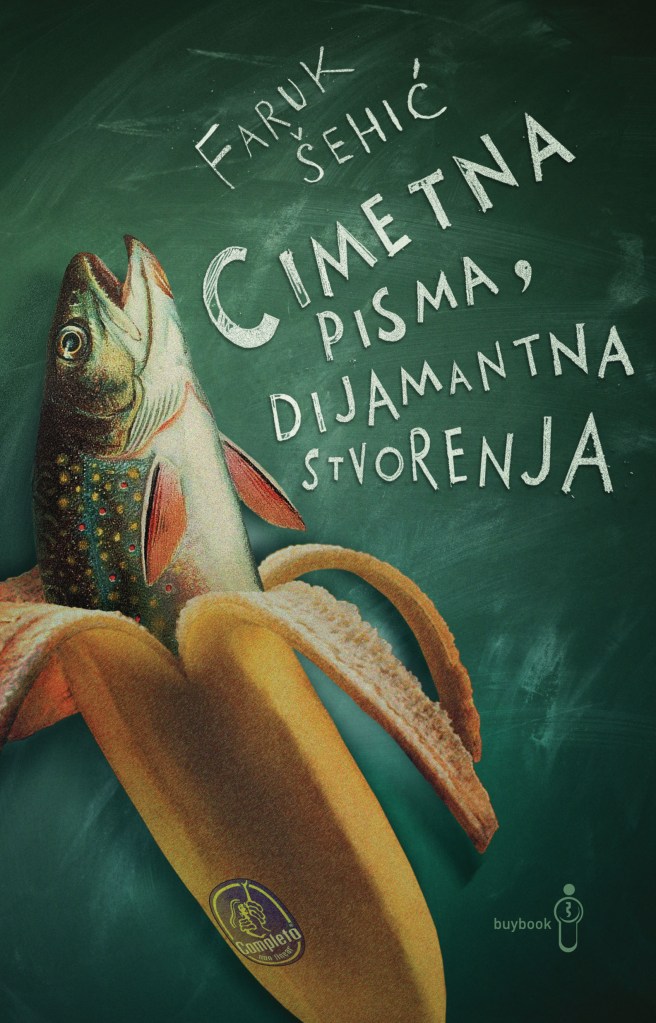
Cinnamon Letters, Diamond Creatures
At night, when the ruined city sleeps, the rubbish proliferates like mushrooms, sends out its mycelia, occupies space, and the air becomes sickly sweet and hard to breathe. The things that still persist, that haven’t yet begun to break down, cannot rebel against the quiet revolution of rubbish as it conquers all the rooms of the house. The untouched, wholesome things know that the progress of rubbish is unstoppable. A wardrobe of solid wood will hold out for a long time, but it too is aware that, in the end, it will fall victim to damp, worms or fire.
That’s why I’m a fighter against rubbish, though I wouldn’t really call it a mission. I don’t want to have any mission in this world or the next, if there is one – if anything exists apart from this ruined city that stretches as far as the eye can see.
Smells are the worst consequence of the spread of rubbish. They’re hard to vanquish. To me, everything smells of sorrow and loneliness. The demise of an era, of entire centuries in which the brilliant human mind devised innovations that would help us live comfortable, quality lives. The end product of the human mind is rubbish, and I become more and more convinced of the process as I see it on the ground every day.
Faruk Šehić, trans. Will Firth
Greta
This transpired at a time when I was still afraid of the dark in the stairwell. The darkness rose from the center of the Earth, spread toward the surface like a web of capillaries, and exited just where the stairwells of tower blocks were. Our block was old, its facade dark-colored, with streaks of green and tiny spangles that gleamed in the sun, that gleamed in the light of the street lamps. The darkness was in league with all the stairwells in the world known to me, which comprised a few streets in town.
The street lamps were special, each one a cluster of three great white orbs on a metal post. Somebody dubbed them mother’s tears, and older boys would make snowballs, press stones into the hearts of them, and with these loaded snowballs, break the tears of the street lamps. The town was full of broken white spheres hanging from curved lamp posts. Although mother’s tears seldom actually came in full complements of three, they shone brightly, especially when they were capped with snow and heralded the arrival of the new year—the smell of exploded firecrackers, the smell of snow in the air, the great excitement of the life ahead.
I developed particular techniques for driving the dark from the stairwell, because at the time there was no electric light in the basement and the dark pushed unstoppably upward, threatening to overcome what little daylight penetrated the cloudy glass of the stairwell door.
Faruk Šehić, trans. Mirza Purić
Women’s War
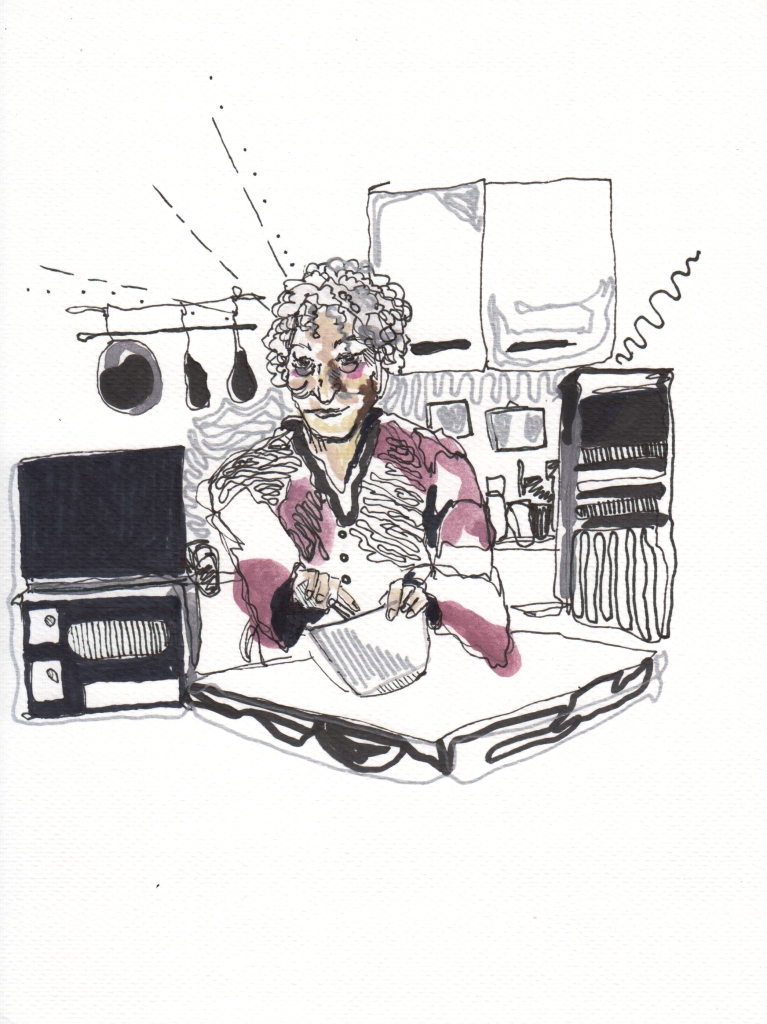
It’s as though Greta and Nađa were two dispossessed noblewomen. Greta, of course, is a countess, Nađa her right hand. They have now been expelled from their county. Nobody knows them; the faces in the street are strange. None treat them with due respect. In turn, the two of them don’t much care what people in their new town think about them. Greta and Nađa listen to the news, remembering the number of shells that have fallen on such and such town on a given day. They remember the number of dead and wounded, because we all do. It’s an informal sport of sorts, it may become an Olympic discipline someday, and it consists of a radio speaker informing us in a distraught voice that such and such number of howitzer, mortar and cannon shells were fired on town XY during an enemy attack on the very heart of the town. Greta and Nađa are able to tell howitzer and cannon shells from one another, because the former fly a lot longer than the latter and you have time to find cover. They learnt this from our father. At times, radio reports made mention of surface-to-air missiles, which are used – ironically enough – not to shoot down aeroplanes but to destroy our cities and towns. For nothing is the way it may at first seem in war. The missiles have poetic names: Dvina, Neva, Volna. The surface-to-surface missile Luna has the prettiest name. One missile landed near our house, the blast lifted a few tiles off the roof. Dry snow seeped through the hole in the roof onto the concrete steps carpeted with varicoloured rag-rug. The cold falls into our home vertically.
Faruk Šehić, trans. Mirza Purić
Illustration: Lejla Zjakić
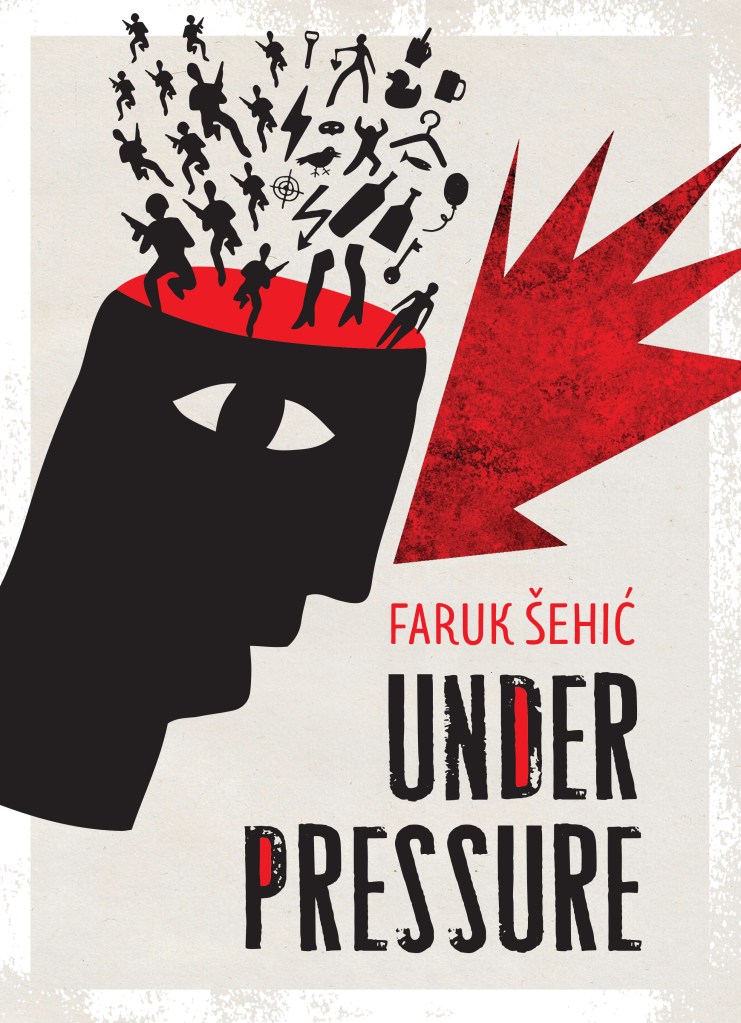
Under Pressure
1.
They’ve brought us to the front line. Mud and fog everywhere. I can barely see the man in front of me. We almost hold onto each other’s belts lest we get lost. We pass between burning houses. The file trudges on along rickety fences. The mud sticks to our boots, stretches like dough. The lines you see for the first time are the best. Everything is new, unusual and hairy as fuck. Especially when you take charge of a position at night, and the next day, in daylight, you realise you’re sitting on the tip of a nail.
Charred beams are falling off roofs, sizzling in the mud. We trudge up a big slope. The grass is slimy with fog. Whenever someone falls, he brings the file to a halt and, as a matter of course, curses a blue streak at the motherland and the president. The very thought that we would sleep out in the open flares up my haemorrhoids. The guide, a military policeman, brings us up to the top of the bump. Emir and I take a shallow trench in which we find: a mattress and a quilt, mud-slarted, and a few fags, smoked down to the filter, nervously stuck into the soil.
– All right lads! Nitherin’, innit? – a voice reaches us from the right-hand side.
– Come over and I’ll tell tha – replies Emir lying on the mattress.
A silhouette approaches from behind.
Hops into the trench.
– I’m from t’ third battalion – he tells us as we shake hands.
– Got a fag?
I open a cigarette case full of Gales, unsmokable Colombian rubbish.
– Ahn’t they gonna see us if we smoke? – asks Emir.
– Neh. They’re far from ’ere, t’ fog’s thick.
Emir and I both light up, as if by order.
– Nah then, what’s t’ lie of t’ land? I ask.
– Is it ’airy?
– They ploughed ’ill over with shells earlier today. A fighter from company B ’ad ’is cheek blown off by shrapnel. On Metla, a fell twice t’ size of ours, they ’ave a coupla ZiS anti-tank guns. They can shoot us like clay pigeons – Third Bat-Boyo recounts slowly.
– So, survivors will eat with golden spoons – Emir heckles.
– Ain’t as bad as it looks – Third Bat-Boyo comforts him – gotta die someday anyroad.
Fear creeps into me like mould. It’s shrapnel shave tomorrow.
Faruk Šehić, trans. Mirza Purić
The Monster from the Juice Warehouse
It was so long ago and I was so small that I find it hard to believe that it all really happened. I learned to walk and talk early and plunged straight into the whirlpool of life. Awake for hours before daybreak, I had to wait for the mechanism that ran the town’s life to start ticking – and then I would rush outside. One morning when I was sliding between puddles, I slipped and fell face-down on the title-page of a wet newspaper clinging to the asphalt, where it said that Salvador All… had been killed (my hand had erased part of the surname). Allende was dead, and I was wounded. I kept running with the open wound on my knee and gripping the wad of newspaper in my hand. The day was a merry labyrinth that I wanted to get lost in, as in someone else’s memory.
Maybe it was exactly the day when I crumpled up dead Salvador Allende that the Monster from the Juice Warehouse answered my persistent questions about how she could stand the loneliness of the icy caves. She gave a short monologue with a few allusions to silence, the cold and loneliness. I don’t remember everything, but some of her words have stuck in my mind because I felt sorry for the Monster.
‘I’d say silence is that feeling. Gar-gar-gargel. Silence floods over the hills where the green banners of the trees and the grass wave in honour of the watery power that nourish them. I don’t see them, except at night when they don’t show their colours because I dare not leave this shelter during the day. The silence isn’t disturbed by the swarms of insects and birds but is enhanced by the holy melodies and rhythms coming from the very heart of existence: the fabric of the Earth or the astral spores – the meteorites that sowed the bacteria of life. Gar-gargel.’
Faruk Šehić, trans. Will Firth
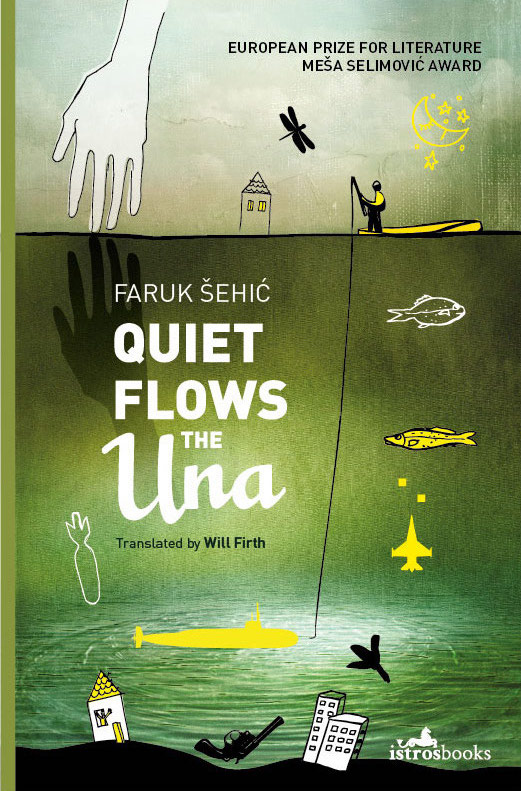
Quiet Flows the Una
Sometimes I’m not me, I’m Gargano. He, that other, is the real me: the one from the shadow, the one from the water. Blue, frail and helpless. Don’t ask me who I am because that scares me. Ask me something else. I can tell you about my memory: about the world of solid matter steadily evaporating and memory becoming the last foundation of my personality, which had almost completely vaporized into a column of steam. When I jump into the past, I’m fully aware of what I’m doing. I want to be whole like most people on this Earth. Now I feel better, staring at the unbroken white line on the steel-blue asphalt. It soothes me. Darkness falls painlessly. I don’t look back. The dark is behind me, but it feels like it’s not there at all; not swallowing up the road, the buildings and the trees. It walks along behind me but dares not come close because it knows that then I would have to use my shield of paper with luminous words, and everything would go down the drain. And no one wants that to happen: neither Gargano, nor the dark, nor that other, meaning me – the astronaut, the adventurer and explorer of rivers and seas.
Faruk Šehić, trans. Will Firth
Fragmenty powieści Książka o Unie, zarejestrowane podczas audycji w Radiu Wrocław Kultura.
Czyta Bartosz Woźny
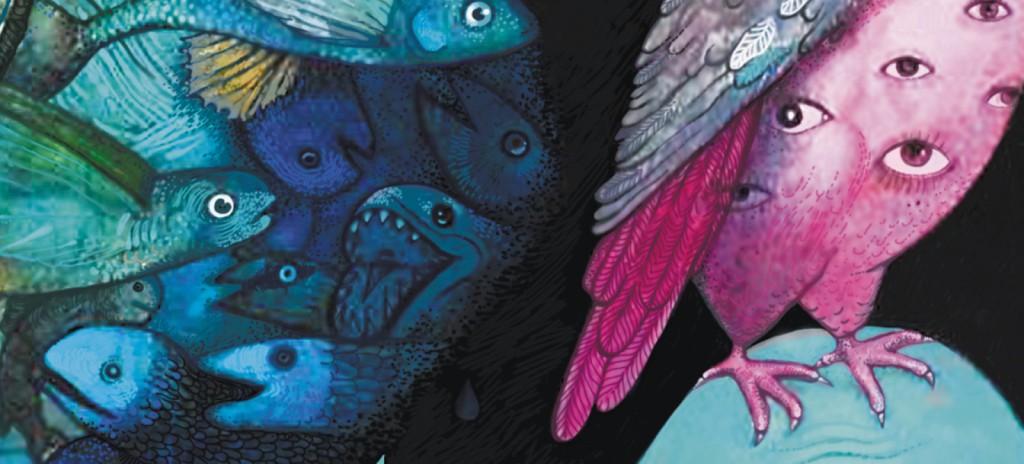
Faruk Šehić reads an excerpt from Knjiga o Uni (The Book of the Una)
The Pandemonium Diary
24
All cities are now physically distant from one another.
Our reality is like a dynamic universe portrayed as an inflating balloon in the theory of its origin. The more it inflates, the further galaxies move away from each other.
So the cities are moving away from each other.
Cities are galaxies where we’re stuck in our flats and houses. Through the windows, we can see other celestial bodies whizzing past us like we’re two full-speed passing trains on parallel tracks. Whenever we open the windows, a gush of scorchingly hot cosmic air greets us (thrusted from a celestial body sweeping by), while the curfew remains in place outside.

